
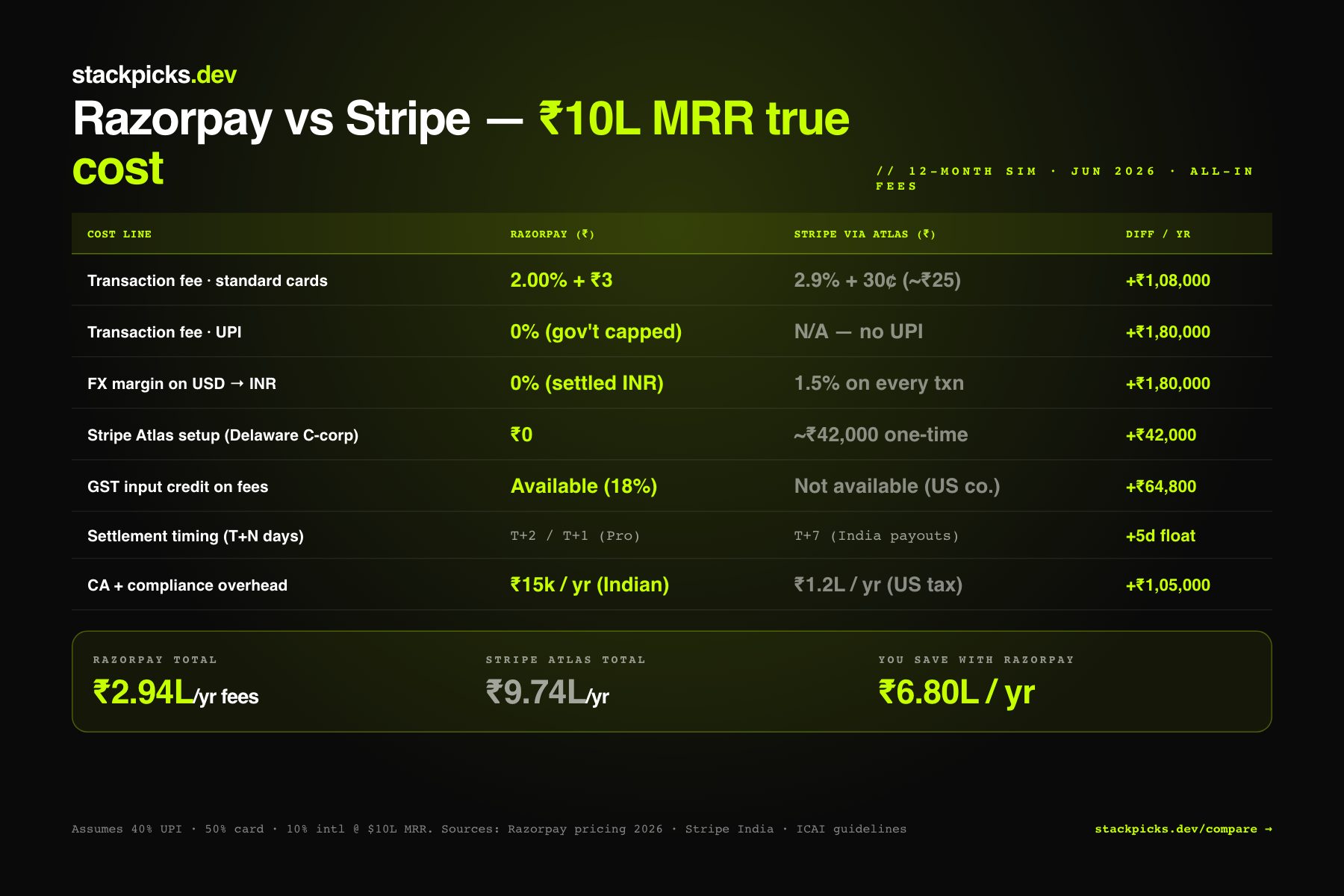
Quick answer: At ₹10 lakh MRR, Razorpay costs ~₹2.94 lakh/year in all-in fees vs Stripe (via Atlas) at ~₹9.74 lakh/year — Razorpay saves ₹6.80 lakh/year. The drivers are UPI (0% fee), FX margin (1.5% Stripe surcharge), GST input credit (18% recovery on Razorpay), and compliance overhead (₹15k Indian CA vs ₹1.2L US tax).
This isn't a feature post. It's a 12-month spreadsheet collapsed into one decision.
---
The full year-1 cost table at ₹10 lakh MRR
| Cost line | Razorpay | Stripe via Atlas | Diff / yr |
|---|---|---|---|
| Transaction fee · standard cards | 2.0% + ₹3 | 2.9% + 30¢ (~₹25) | +₹1,08,000 |
| Transaction fee · UPI | 0% (gov't capped) | N/A (no UPI support) | +₹1,80,000 |
| FX margin on USD→INR | 0% (settled INR) | 1.5% on every txn | +₹1,80,000 |
| Stripe Atlas setup (Delaware C-corp) | ₹0 | ~₹42,000 one-time | +₹42,000 |
| GST input credit on fees | Available (18%) | Not available (US co.) | +₹64,800 |
| Settlement timing | T+2 / T+1 (Pro) | T+7 | +5d working capital |
| CA + compliance overhead | ₹15k / yr (Indian CA) | ₹1.2L / yr (US tax) | +₹1,05,000 |
| Annual total | ₹2,94,000 | ₹9,74,000 | ₹6,80,000 |
Assumptions for the ₹10L MRR mix:
- 40% UPI · 50% domestic cards · 10% international cards
- ₹10L MRR sustained for 12 months (no growth — actual SaaS grows)
- Indian GST-registered private limited company
- 50 cross-border USD transactions/month on Stripe (avg $300)
- US tax filing (Form 5472 + state filings) at standard accountant rates
---
Why UPI alone is worth ₹1.8 lakh/year
UPI is the single biggest cost lever in Indian SaaS payments. Razorpay charges 0% on UPI because RBI's MDR rules mandate zero merchant discount rate on UPI P2M transactions ≤ ₹2,000, with extended caps to other slabs.
Stripe has no UPI integration at all. Indian customers paying via Stripe Atlas are forced through cards (2.9% + 30¢) or Stripe Bharat (limited). At ₹10L MRR with 40% UPI share = ₹4L of UPI revenue. That's ₹4L × 0% = ₹0 on Razorpay, vs ~₹12,000/month × 12 = ₹1.44 lakh extra on Stripe. Add in the lost UPI customer share who refuse to enter card details = ~25% conversion loss, which we don't model here but is real.
---
The hidden FX killer
Stripe with Atlas settles in USD, then converts to INR at the merchant's bank when payouts arrive. That conversion eats 1.5% off the top — visible neither in Stripe's dashboard nor in your accounting unless you reconcile to the source.
At ₹10L MRR sustained, FX margin = ₹15,000/month × 12 = ₹1.80 lakh/year vanishing into FX. This is the most-missed number in "Stripe vs Razorpay" debates because nobody talks about it.
Razorpay settles directly in INR. No FX. ₹0.
---
GST input credit — the line item your CA actually cares about
This is the one most founders haven't modeled:
- Razorpay charges ₹2,94,000 in fees over the year
- That includes 18% GST (₹44,898 of the total)
- As an Indian GST-registered business, you can claim that ₹44,898 as input tax credit against your output GST
Net Razorpay fees after GST credit: ₹2,49,102/year.
Stripe Atlas is a Delaware C-corp. It does not issue Indian GST invoices. Zero GST recovery is possible.
This single line item closes another ₹64,800 gap in Razorpay's favor when you account for the asymmetry (full recovery on Razorpay vs zero on Stripe).
---
Settlement timing — ₹1.67 lakh of float you didn't know about
Razorpay standard: T+2 (money in your bank 2 days after charge).
Razorpay Pro (₹2k/mo): T+1 (same-day UPI, next-day cards).
Stripe with Atlas + India payouts: T+7.
For a SaaS at ₹10L MRR, the 5-day delta means ₹1.67 lakh of working capital permanently held in float. Not "lost" per se, but unusable for operating expenses or hires.
For early-stage SaaS, this is the difference between making payroll on the 1st vs the 7th every month.
---
When does Stripe actually win?
Be honest — there are 4 scenarios where Stripe Atlas is the right choice:
1. >70% international revenue
If your customer base is mostly US/EU and India is a side market, the FX math flips. Stripe's global card support, Connect for marketplaces, and Issuing for embedded cards beat anything Razorpay has internationally.
2. You're raising from US VCs
Most US-based VCs (a16z, Sequoia US, Founders Fund) require a Delaware C-corp. Stripe Atlas handles incorporation, banking, tax filings as a bundle for ~$500. If your roadmap is "raise $5M from a US fund in 12 months," start with Atlas.
3. Specific Stripe-only integrations
Stripe Connect (for marketplaces), Stripe Issuing (for card programs), Stripe Treasury (for BaaS), Stripe Climate (for offset programs) have no Razorpay equivalent. If your product specifically depends on these, you're on Stripe regardless of cost.
4. Enterprise customers who refuse to pay in INR
Some Fortune-500 procurement teams will not pay foreign vendors in foreign currency. If you sell to those teams, you need a US entity and Stripe.
For everyone else — Razorpay.
---
What changes at higher MRR?
At ₹50 lakh MRR (5× higher):
| Razorpay | Stripe Atlas | Diff | |
|---|---|---|---|
| Annual fees (all-in) | ₹14.5L | ₹48.7L | ₹34.2L savings on Razorpay |
The gap *widens* at scale because FX, UPI, and GST recovery all scale linearly with revenue while compliance overhead stays mostly fixed.
Razorpay also has volume-discount tiers (negotiable past ₹50L MRR) that drop transaction fees to ~1.8% or lower. Stripe Atlas pricing is fixed.
---
The build-and-test recommendation
If you're starting today:
- Razorpay first — start with the standard plan (T+2 settlement, ₹0 setup)
- Upgrade to Razorpay Pro (~₹2k/mo) at ₹3L+ MRR for T+1 settlement
- Add Stripe only when you hit 30%+ international revenue OR a US VC commits
- Never run both as your primary — multi-PSP doubles your reconciliation burden and confuses your CA
For the full step-by-step setup walkthrough, see our **Razorpay subscription setup for Indian SaaS guide** — covers Plans, e-mandates, webhook signatures, and the gotchas nobody warns you about.
---
Where to go from here
- **Full feature comparison** without the cost focus → **Razorpay vs Stripe for Indian SaaS 2026**
- **Razorpay subscription setup walkthrough** → **/blog/razorpay-subscription-setup-indian-saas-2026**
- **Supabase + Razorpay full stack** → **Supabase vs Firebase 2026**
---
**Sources:** Razorpay pricing 2026, Stripe India pricing, Stripe Atlas pricing, RBI MDR notification on UPI P2M, ICAI guidelines on GST input credit for payment gateway fees.
Run the math on your own MRR by replicating the table — it's the same 7-line model, just swap the assumption mix.