
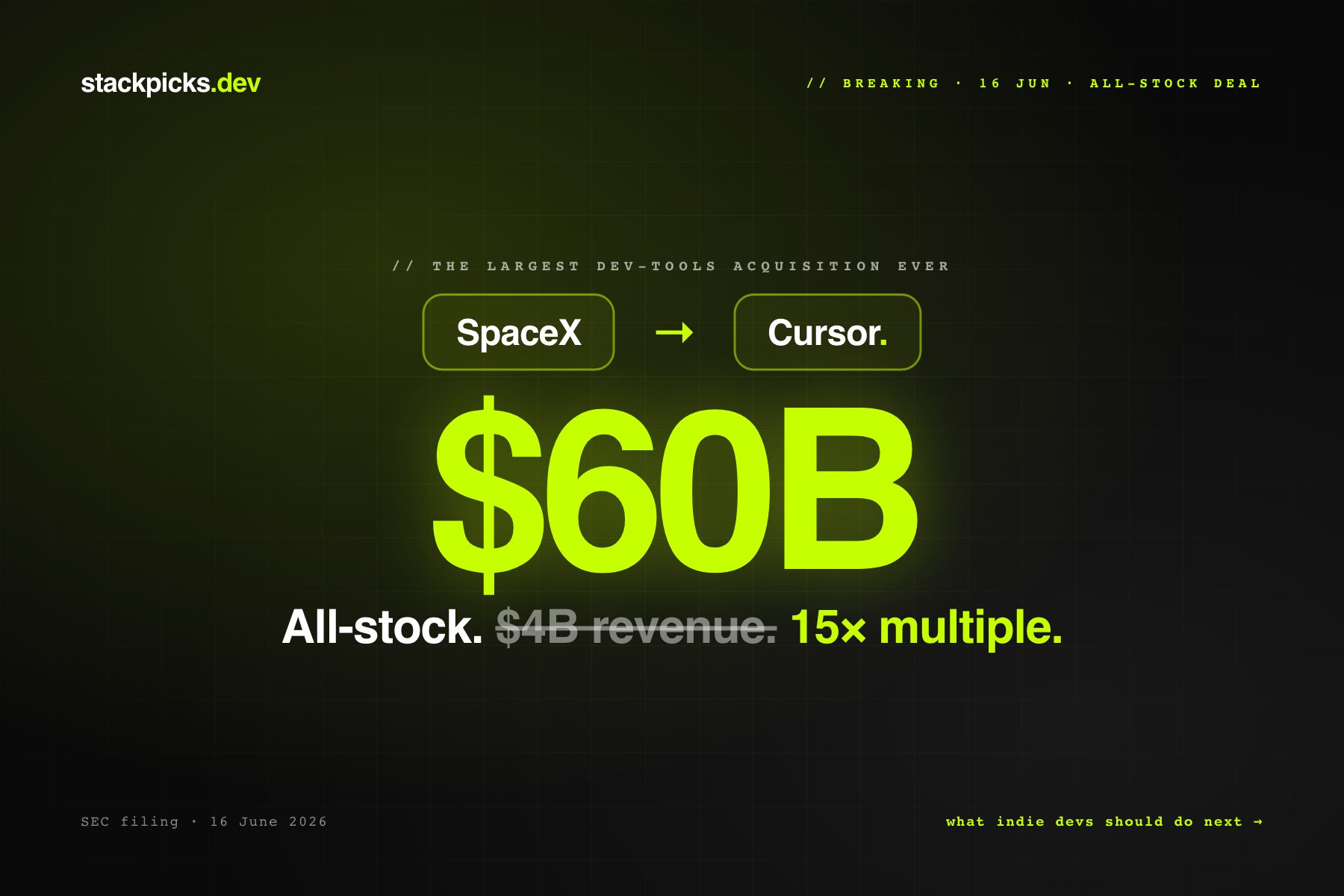
**Quick answer:** SpaceX filed an all-stock $60 billion acquisition of Cursor on 16 June 2026 — the largest dev-tools deal in history. Cursor users keep working as-is for now. Three indie-dev paths forward: stay (lowest switching cost), switch to **Windsurf** (closest equivalent at half the price), or move to **Claude Code** (terminal-native, Anthropic-owned).
---
What actually happened
SpaceX (yes, Elon's SpaceX, not xAI directly — though the two are tightly connected) filed an 8-K with the SEC on 16 June 2026 covering an all-stock acquisition of Anysphere Inc., Cursor's parent company. Headline number: $60 billion.
Three things make this deal unusual:
- All-stock. No cash component. Cursor employees and existing investors take SpaceX shares — locked up for 24 months per the filing. That's a structural bet on SpaceX's IPO trajectory more than a liquidity event.
- Co-trained model already running. Buried in the filing footnotes: SpaceX and Cursor have been co-training a coding-specific model on the Colossus supercluster in Memphis for "several months." That model is being tested live inside Cursor and Grok Build — meaning the integration started months before the deal was announced.
- 15× revenue multiple. Cursor reportedly generates $4B annualized with 50,000+ enterprise customers and ~2/3 of the Fortune 500. At $60B, the multiple lines up with the Figma–Adobe ($20B, since abandoned) and GitHub–Microsoft ($7.5B in 2018) comparable deals, scaled to 2026 valuations.
---
What changes for Cursor users today
Short answer: nothing visible. Cursor's IDE, pricing ($20/mo Pro), rules system, and model selector all work the same on 25 June 2026 as they did on 15 June.
The first observable change is live but optional: a new "xAI Code (preview)" model now appears in the model picker alongside Claude Sonnet 4, GPT-5, and the existing options. This is the co-trained model from the Colossus supercluster. Anecdotal early reviews on r/cursor: roughly Sonnet 4-level on Python, weaker on TypeScript edge cases, surprisingly good on Rust.
What to watch over the next 90 days:
- Forced default model — if "xAI Code" becomes the default and you have to manually re-select Sonnet/GPT-5 every session, that's the canary
- Telemetry expansion — check the Privacy tab for any new "share completion data with xAI affiliates" toggle that's default-on
- Terms of Service update — post-close (expected Q3 2026), a new ToS lands. Read the data-use section carefully
---
The three indie-dev paths forward
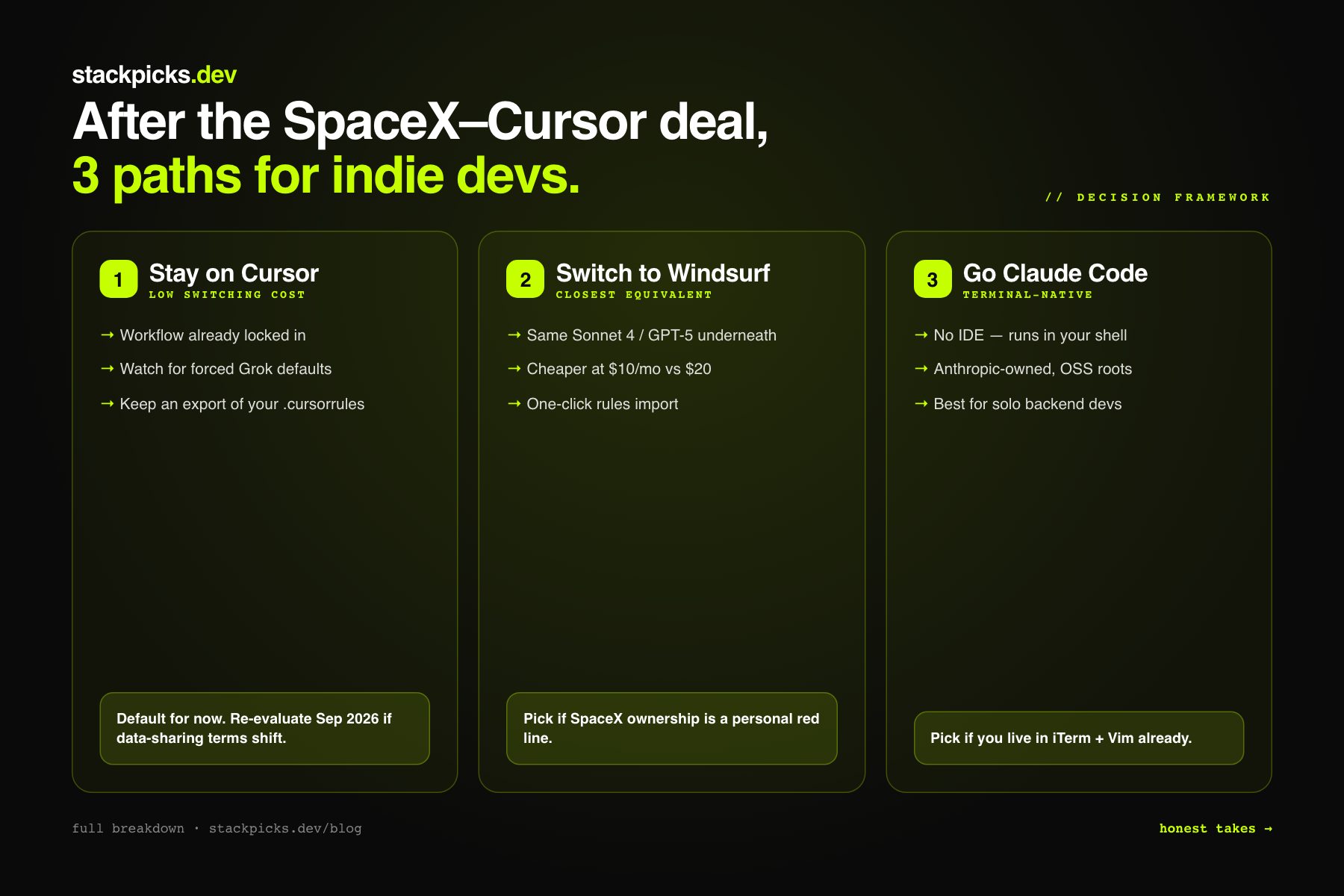
For indie founders and solo devs, the decision splits cleanly into three lanes:
Path 1: Stay on Cursor (default for most)
Switching cost: lowest. Your workflow already works. Your .cursorrules and shared snippets aren't transferable to alternatives without manual conversion. The model quality is fine — Sonnet 4 and GPT-5 are still selectable.
Action:
- Keep working
- Export your
.cursorrulesfile (Cmd+Shift+P → "Export Rules") and save it to your dotfiles repo as a backup - Set a calendar reminder for 15 September 2026 to re-evaluate after the deal closes and the new ToS lands
Path 2: Switch to Windsurf (best 1:1 replacement)
Switching cost: low. Windsurf is the closest functional equivalent — same Sonnet 4 / GPT-5 models underneath, similar inline-chat UX, but at $10/mo vs Cursor's $20. It has one-click .cursorrules import, so your existing rule library moves over in under 60 seconds.
Action:
- Sign up at windsurf.ai
- Import your
.cursorrulesvia Settings → Import → Cursor - Trial it on one project for two weeks before fully cutting over
Pick this if: SpaceX ownership is a personal red line, or you want to save $120/year per developer.
Path 3: Move to Claude Code (terminal-native, Anthropic-owned)
Switching cost: medium-high. Claude Code is a different paradigm — no IDE, runs in your shell. Best for backend developers who already live in iTerm/tmux/Vim. Anthropic owns it directly (not a third-party wrapper), so the data-handling story is clean.
Action:
- Install:
npm install -g @anthropic-ai/claude-code - Start the
claudecommand in your project root - The learning curve is real (1–2 weeks of muscle memory) but the output quality on complex refactors is best-in-class
Pick this if: You're already comfortable in the terminal and you want the Anthropic-direct relationship.
---
What this deal signals for AI coding tools
Three structural shifts indie devs should plan for:
- AI coding tools are now infrastructure. At $60B, this isn't a productivity-tool play — it's an infrastructure-tier deal. Expect Microsoft + Google to respond with similar consolidation moves (Microsoft already owns GitHub Copilot; Google's Gemini Code Assist needs an acquisition target). Smaller AI coding tools without integrated models will struggle to compete.
- Integrated model + IDE is the moat. The Colossus co-training is the giveaway. The next decade of dev-tools competitive moats sit at the "model trained for our IDE" intersection, not just "IDE with API calls to whatever model." Cursor + xAI Code is the first mover; Windsurf will need its own model partnership; Claude Code already has it via Anthropic.
- **Open-source alternatives become strategic.** **Continue.dev** (open-source, self-hostable) and **Aider** (terminal, BYO-key) become more interesting in this landscape — not because they'll match Cursor on UX, but because they're the only way to keep your code air-gapped from the consolidation wave.
---
Our honest take
For 90% of indie devs reading this: stay on Cursor for now, export your rules as a backup, set a September re-evaluation reminder, keep a Windsurf account warm. Don't migrate on principle when the data terms haven't changed.
For the 10% where SpaceX/xAI ownership is a real red line (regulated industries, EU privacy-conscious teams, anyone with strong views): Windsurf today, Claude Code in 3 months once you've adapted your workflow.
The full side-by-side breakdown — features, pricing, models supported, output quality benchmarks — is in our **Cursor 2 vs Windsurf vs Claude Code 2026 comparison**. For the curated full list of AI coding tools by use case, see **AI tools by use case**.
---
We'll update this post when the deal closes and the post-close ToS lands. Bookmark this page if you're on the fence.
For the broader 2026 dev-tools landscape — what's still independent, what's been acquired, what's open-source — see our **curated open-source dev tools directory** at stackpicks.dev.