
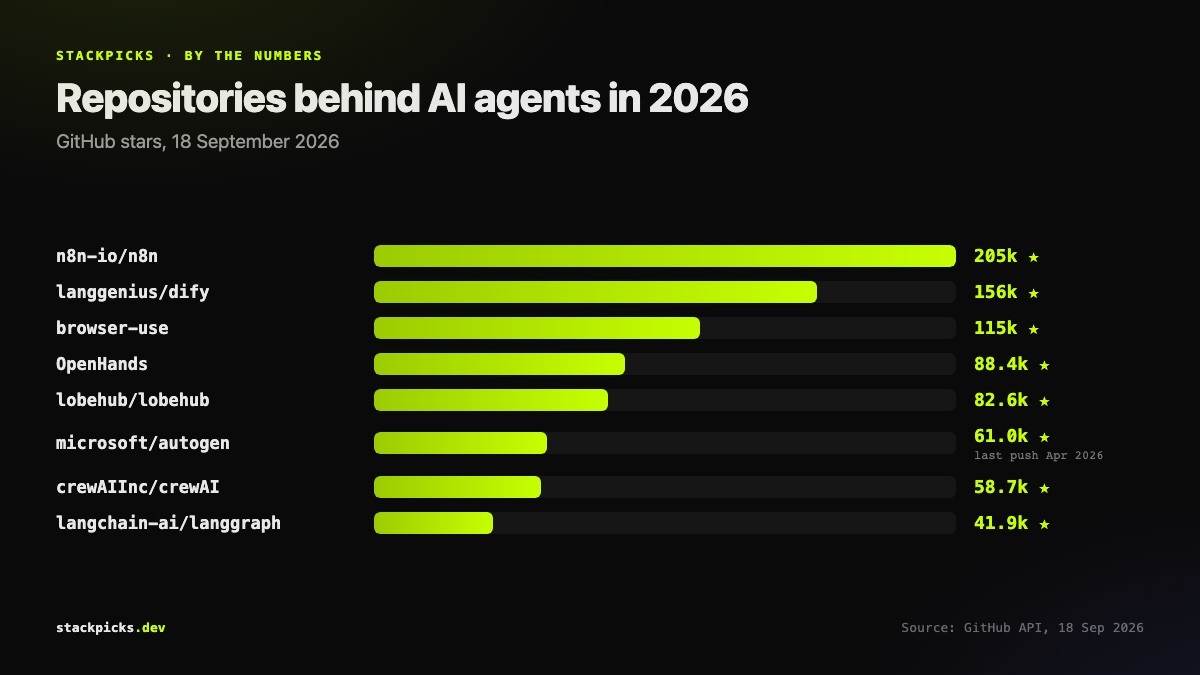
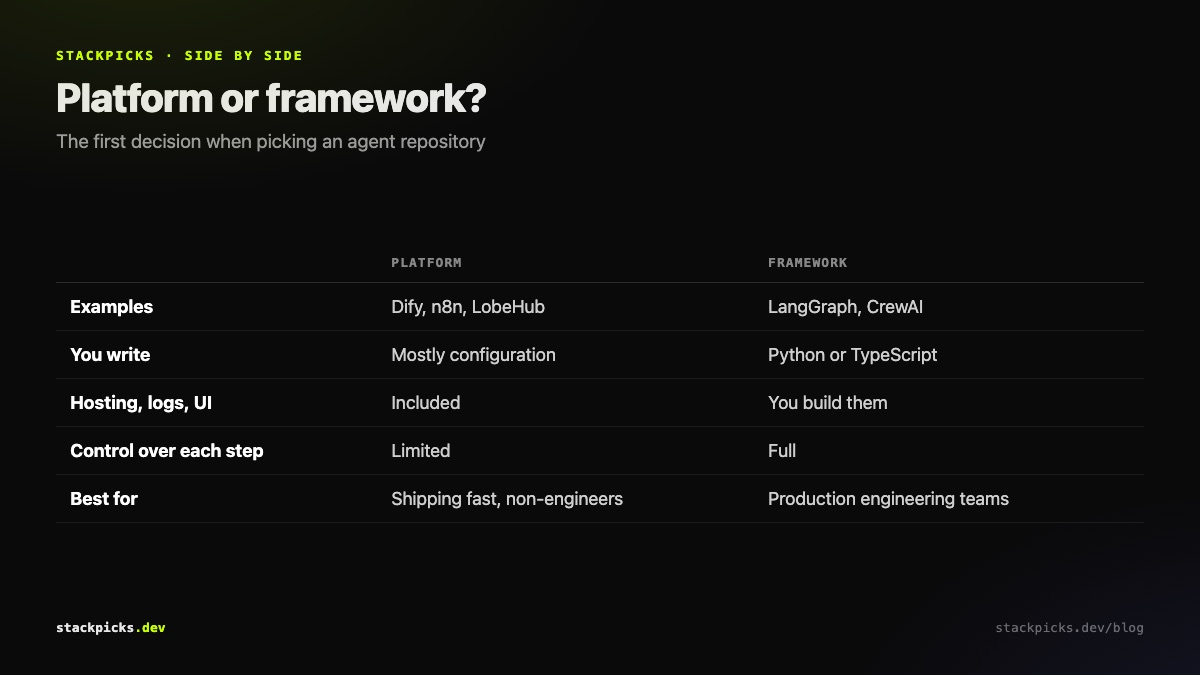
Short version: decide first whether you want a platform or a framework. Platforms (Dify, n8n) are faster to ship with; frameworks (LangGraph, CrewAI) give you control. Add browser-use if your agent must operate websites, and OpenHands if the agent writes code. Stars and push dates below are from the GitHub API on 18 September 2026.
Platforms: build agents visually
- **n8n** (about 205,000 stars): workflow automation with native AI steps. Fair-code licence.
- **Dify** (about 156,000): agentic workflows and RAG pipelines with a visual builder and model management.
- **LobeHub** (about 83,000): a workspace for organising and running agents.
Frameworks: write agents in code
- **LangGraph** (about 42,000, MIT): explicit, stateful agent graphs for production.
- **CrewAI** (about 59,000, MIT): role-based multi-agent setups, quick to start.
- **AutoGen** (about 61,000): Microsoft's multi-agent framework. Its last code push was in April 2026, so check the README for current guidance.
Agents that use the browser
- **browser-use** (about 115,000, MIT): lets a model operate a real browser, for sites with no API.
- **UI-TARS-desktop** (about 39,000): ByteDance's multimodal agent stack for operating desktop interfaces.
Agents that write code
- **OpenHands** (about 88,000, MIT): autonomous coding in a sandbox.
How to choose
- Who is building it?
- Ops or marketing team: a platform such as Dify or n8n.
- Engineers: a framework such as LangGraph or CrewAI.
- What does the agent touch?
- APIs: any of them, through tools or MCP.
- Websites without APIs: browser-use.
- A codebase: OpenHands or a coding agent.
- Check maintenance and licence.
- Look at the last push date and the licence file of the version you deploy.
For a deeper comparison of the frameworks alone, see our open-source agent frameworks guide.