All posts
AI Engineering·7 min read·Updated 18 Sept 2026

Claude Code vs Codex (2026): Pricing, Features and Which to Pick

Quick answer
Claude Code and OpenAI Codex both start at $20 a month for real coding use. Pick Claude Code for complex multi-file refactors, hooks and MCP-heavy workflows; pick Codex for terminal-native work and parallel cloud tasks, or to start on OpenAI's cheaper tiers. Both read SKILL.md skills, so switching costs are low.

Claude Code vs OpenAI Codex in 2026: plan-by-plan pricing, where each agent is stronger, MCP and Agent Skills support, and when running both makes sense.

Piyush Jangir
Verified author

Founder of StackPicks. Self-taught builder shipping open-source dev tools, marketing, and curator content since 2019. Based in Mumbai, India. Available on GitHub and LinkedIn.

7 min read
Claude Code vs Codex (2026): Pricing, Features and Which to Pick

Short version: at the plans most people buy, Claude Code and Codex cost the same. The choice is about working style. Claude Code is the stronger pick for long, ambiguous, multi-file work and for teams that lean on hooks and MCP. Codex is the stronger pick for terminal-native developers who want to fan well-defined tasks out to parallel cloud runs. Both now read the same Agent Skills format, which makes this a far less permanent decision than it was a year ago.
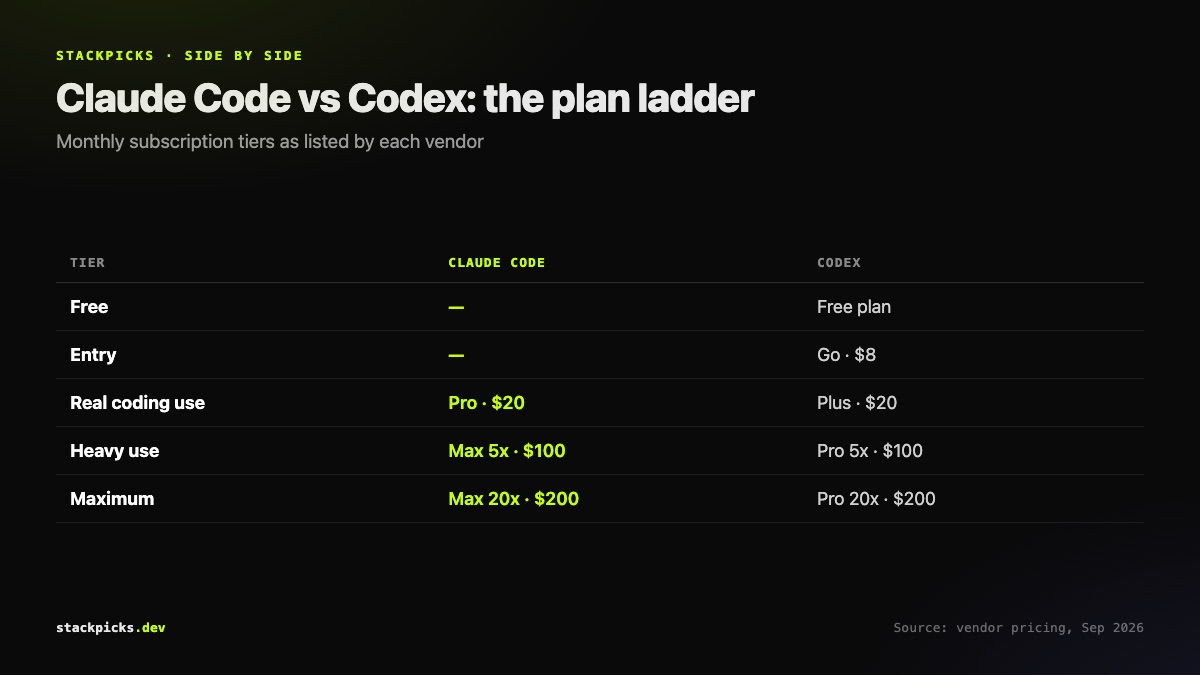
Claude Code vs Codex subscription tiers side by side

Pricing, plan by plan

Both vendors meet at $20 a month for real coding use: Claude Pro for Claude Code, ChatGPT Plus for Codex. Above that the ladders mirror each other at $100 and $200. OpenAI additionally offers a free plan and an $8 Go plan, so if you want to try an agent without paying, Codex has the cheaper on-ramp. Check each vendor's pricing page before buying, because limits inside each tier change more often than the prices do.

What each one is

Claude Code is Anthropic's coding agent. It runs in the terminal, as a desktop app, on the web, and inside VS Code and JetBrains, all on the same engine. Its extension points are hooks, skills, plugins and MCP servers.

**Codex** is OpenAI's coding agent. The Codex CLI is open source under Apache-2.0 and runs locally with OS-level sandboxing, and Codex can also run tasks in OpenAI's cloud in parallel.

Where Claude Code is stronger

  • Long, ambiguous tasks where the agent has to plan across many files.
  • Workflows built on hooks, which run your own scripts at defined points in a session.
  • Heavy MCP use, with local, project and user scopes that make team sharing straightforward.

Where Codex is stronger

  • Terminal-first developers who want an open-source client they can read and modify.
  • Well-specified tasks that can be split up and run in parallel in the cloud.
  • Starting free, or on the $8 tier, before committing.
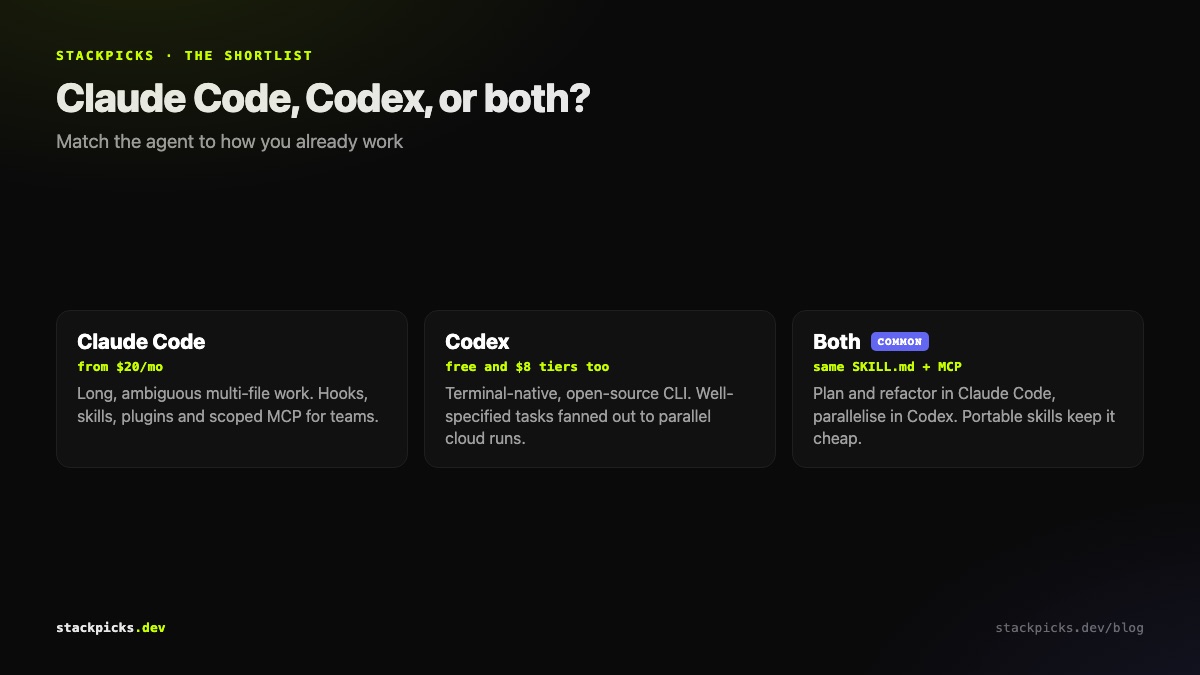
When to pick Claude Code, Codex, or both

The part that changed in 2026: skills and MCP are portable

Agent Skills became an open standard, and Codex, Gemini CLI, GitHub Copilot and Cursor read the same SKILL.md format as Claude Code. MCP is shared too. Adding Atlassian's official server looks like this in each tool:

claude mcp add --transport http atlassian https://mcp.atlassian.com/v2/mcp
codex mcp add atlassian --url https://mcp.atlassian.com/v2/mcp

If you keep your skills in the repository and your MCP servers documented, moving between the two, or using both, costs an afternoon rather than a rewrite. Browse portable skills in the Agent Skills directory.

Our take

Pick the tool that matches how you already work, not the benchmark of the week. If you think in plans and refactors, start with Claude Code. If you live in the terminal and want to parallelise, start with Codex. Keep your skills portable either way.

Frequently asked questions

Is Claude Code or Codex cheaper?+

At the tiers most developers use, they cost the same: $20 a month for Claude Pro or ChatGPT Plus, $100 for the 5x tiers, and $200 for the 20x tiers. OpenAI also has a free plan and an $8 Go plan below that, which Anthropic does not. The real difference is how far each plan stretches on your workload, which depends on the models you use and how much context your sessions carry.

Is Codex open source?+

The Codex CLI is open source under the Apache-2.0 licence and is one of the most-starred coding-agent repositories on GitHub, with about 125,000 stars in September 2026. The models it calls are not open, and cloud tasks run on OpenAI infrastructure. Claude Code is not open source, though its behaviour is extensible through hooks, skills, plugins and MCP servers.

Can I use the same MCP servers with Claude Code and Codex?+

Yes. Both are MCP clients. Claude Code adds a remote server with claude mcp add --transport http <name> <url>, and Codex with codex mcp add <name> --url <url>. Vendor servers such as Atlassian publish both commands in their READMEs. Your credentials and scopes are configured separately in each tool, so plan for doing the setup twice.

Do Claude Code skills work in Codex?+

Mostly, yes. Agent Skills became an open standard at agentskills.io, and Codex, Gemini CLI, GitHub Copilot, Cursor and others read the same SKILL.md format. A skill that only uses instructions and plain scripts usually carries over unchanged. Skills that depend on a specific tool's features, such as Claude Code hooks, need adjusting.

Should I use both Claude Code and Codex?+

Plenty of developers do, because the costs are similar and the strengths differ. A common split is Claude Code for planning, refactors and debugging, and Codex for well-specified tasks that can run in parallel in the cloud. Keeping skills in SKILL.md and MCP servers documented in the repository makes running both cheap to maintain.

More in AI Engineering

Claude Code vs Codex (2026): Pricing, Features and Which to Pick — StackPicks — StackPicks