
**Short version:** most wasted tokens in Claude Code come from context you are carrying but no longer need. Measure it with `/context`, then clear, rewind or compact deliberately, route easy work to a smaller model, and stop loading tools you do not use. Everything below is based on Anthropic's own cost management guide plus the tools people are actually installing.
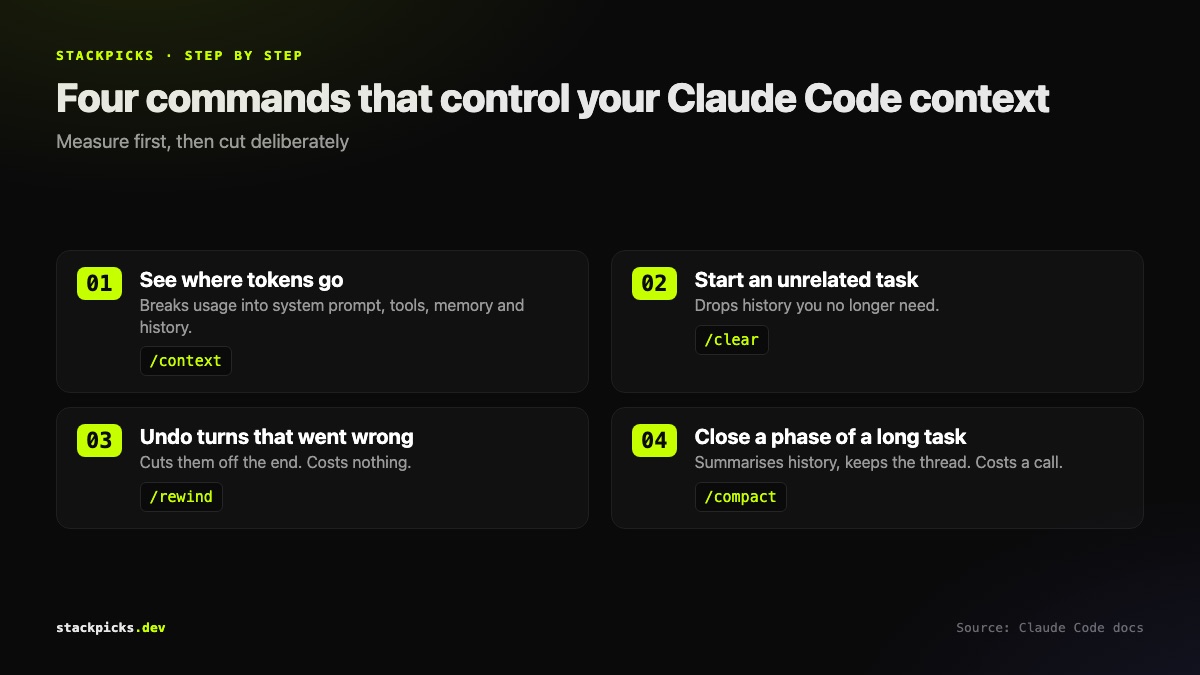
1. Measure before you cut: /context
Run /context inside a session. It breaks usage into the system prompt, tool definitions, memory files and conversation history. That one view tells you which of the fixes below matters for you. If tool definitions are large, fix your MCP list. If history dominates, fix how you clear and compact.
For tracking over days rather than one session, codeburn is a free local tracker that reads your usage logs across several coding tools.
2. /clear between unrelated tasks
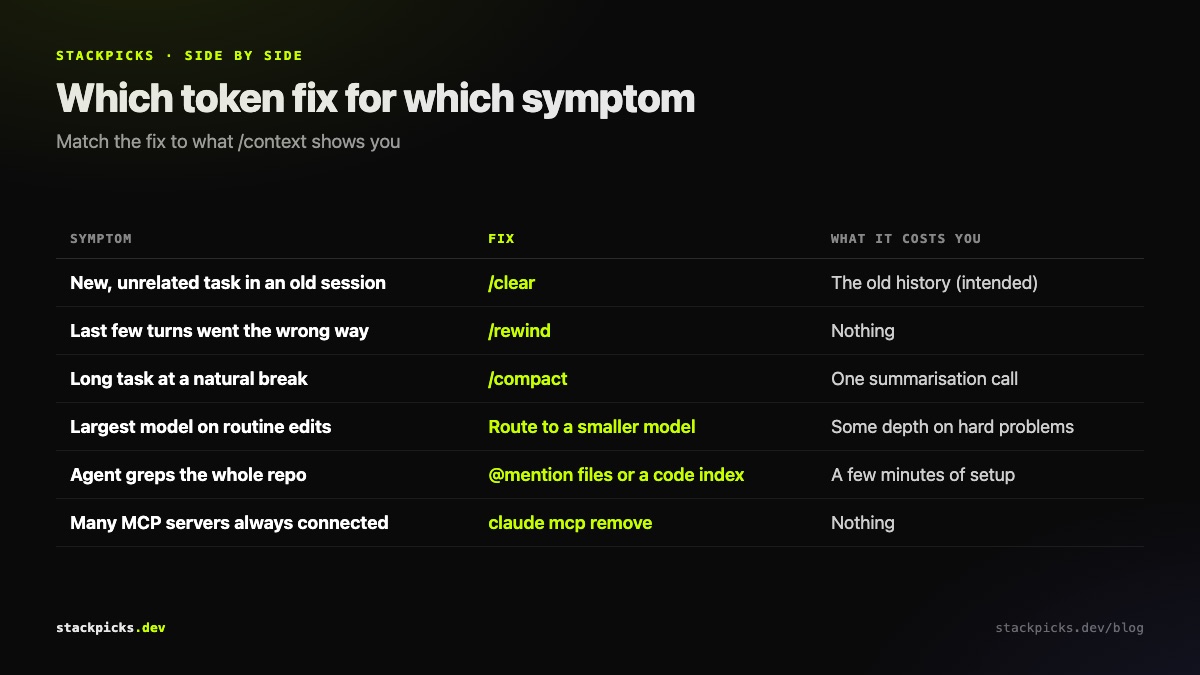
Every turn resends the accumulated history. Finishing a bug fix and then asking about an unrelated feature in the same session drags the whole bug-fix conversation along. Run /clear when the task changes.
3. /rewind when a turn went wrong
If the last few turns went somewhere you do not want, /rewind to just before them. It cuts those turns off and costs nothing. Reaching for /compact instead rewrites the entire conversation and always costs a call.
4. /compact at phase breaks, not when things degrade
In a long task with natural phases, compact when a phase ends: design done, implementation starting. Compacting only once the session feels sluggish means you already paid for the bloated turns.
5. Route work to the right model
Model routing is usually the largest single saving. Keep a mid-size model as the default, send mechanical work to a small one, and reserve the largest model for hard debugging and design decisions.
6. Lower the effort level for routine work
Higher effort means more thinking tokens. Renames, test scaffolding and small edits rarely need it. Keep high effort for problems where you would want a senior engineer to slow down.
7. Keep CLAUDE.md short
CLAUDE.md loads into every session, so every line is a fixed cost on every request. Keep project rules, commands and pitfalls. Move long background material into files Claude reads only when relevant, or into a skill that loads on demand.
8. Point, do not search
Mention files with `@path/to/file` instead of asking Claude to find them. Letting it explore a large repository means grep and read calls whose output lands in context. For big codebases, a code index such as CodeGraph lets the agent query structure over MCP instead of reading files wholesale.
9. Disconnect MCP servers you are not using
Tool definitions from every connected server load into every session. List what you have with claude mcp list and remove the rest with claude mcp remove <name>. Scope project-only servers with --scope project so they load only where needed.
What about token-saving skills?
Skills such as caveman, built on the idea of saying less to spend less, have become some of the most-starred repositories on GitHub this year. They can help, but measure your own before-and-after with /context or a tracker rather than trusting a headline number. Your workload is not the author's.
The habit that saves the most
Interrupt early. When Claude heads down the wrong path, press Esc and redirect instead of letting it finish. A wrong approach that runs for twenty turns costs twenty turns of context, and then you pay again to undo it.