
Short version: The 2026-07-28 MCP specification deprecates Dynamic Client Registration in favour of Client ID Metadata Documents, moves Tasks out of the experimental core into an extension, and puts Roots, Sampling and Logging on a twelve-month deprecation clock. Nothing breaks today. DCR-based auth is the one thing worth planning a migration for.
What actually changed
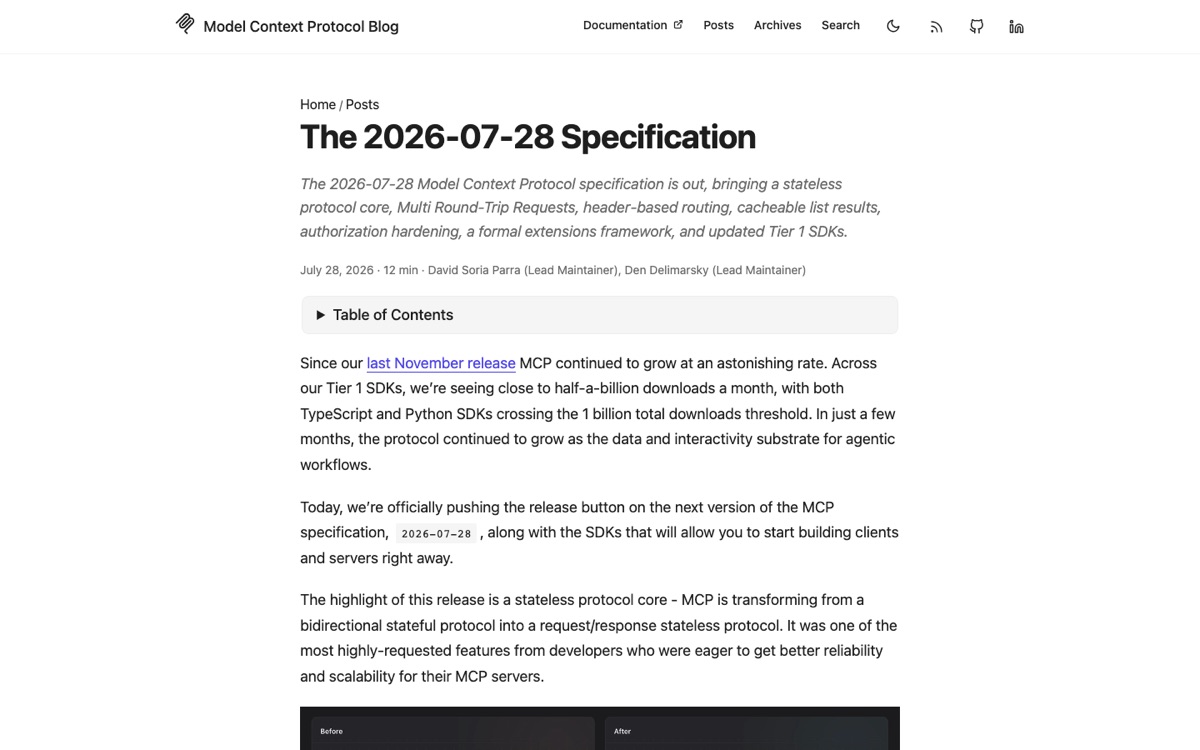
The official release post from lead maintainers David Soria Parra and Den Delimarsky frames the headline as the stateless protocol core. MCP is moving from a bidirectional stateful protocol to request/response. Underneath that headline sit four changes that matter more to anyone already running a server:
| Change | Status | Your move |
|---|---|---|
| Dynamic Client Registration | Deprecated, prefer CIMD | Plan a migration if you use DCR for auth |
| Tasks | Moved core to extension | Update the import path |
| Roots, Sampling, Logging | Deprecated, 12-month support | Audit usage, no rush |
| Stateless core | New default | Delete session affinity infrastructure |
Why DCR is going away
Dynamic Client Registration let a client register itself with an authorization server at runtime and receive a client ID back. That is a stateful step: the server has to store the registration and the client has to hold the result.
Client ID Metadata Documents invert it. The client's ID *is* a URL, and that URL resolves to a document describing the client. The authorization server fetches it when needed. There is nothing to store and nothing to synchronise, which is the same reasoning that drove the stateless core.
If your MCP server does not implement its own authorization, this does not affect you.
The scale context
Two numbers from the maintainers, worth citing because they are first-party rather than analyst estimates: Tier 1 SDKs are pulling close to **half a billion downloads a month**, and the TypeScript and Python SDKs have each crossed **one billion total downloads**. The MCP Registry, launched in September 2025, indexes roughly two thousand servers.
That scale is precisely why the stateless rewrite happened. Sticky sessions are tolerable at a hundred servers and painful at two thousand.
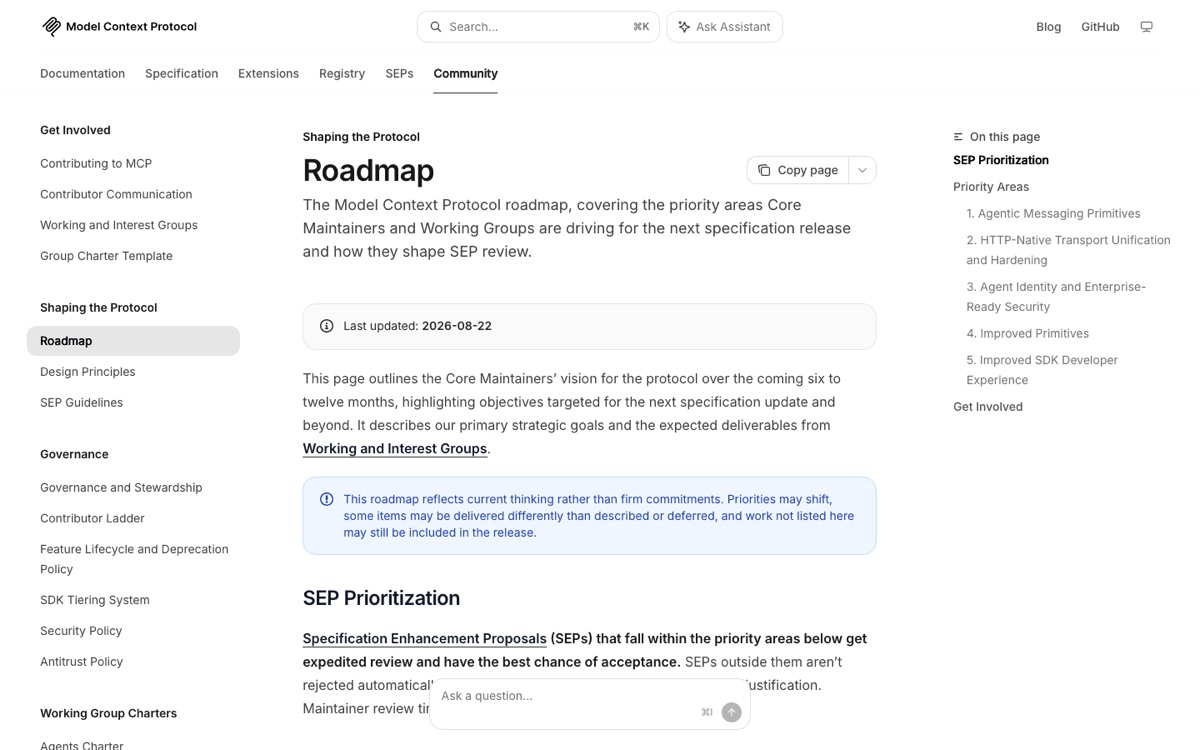
The roadmap points where this is heading: Demonstrating Proof of Possession (DPoP) is being finalised, and Agent Identity work aims to give servers an opinionated way to be reached by an agent acting under its own identity or a user-delegated one. CIMD is the first step on that path, not a one-off change.
What to do this week
- Search your codebase for Dynamic Client Registration. If it is absent, you are largely done.
- If you import Tasks from the core, repoint it at the extension.
- Grep for Roots, Sampling and Logging usage and note it. You have twelve months.
- If you built session affinity purely to keep MCP working, schedule its removal.
Our take
The deprecation policy is the underrated part of this release. MCP previously changed without a formal commitment about how long the old way keeps working. A stated twelve-month window turns "we might break your integration" into a plannable date, which is what a protocol needs before serious infrastructure is built on it.
The stateless core will get the attention, but the policy is what makes the next change survivable.
Where to go next
- The full 2026-07-28 spec breakdown covers MCP Apps and Tasks in depth
- MCP server security checklist for the auth side
- Browse the 106 MCP servers we track, with install commands and security classification
Sources
- The 2026-07-28 Specification, Model Context Protocol blog, 28 July 2026
- MCP roadmap, modelcontextprotocol.io