**Short version:** instead of giving every agent its own API keys and hoping it behaves, you route tool calls through one gateway that knows who is calling and what they are allowed to do. Facts are from the Tool Gateway docs; LangChain announced the public beta on 19 November 2026.
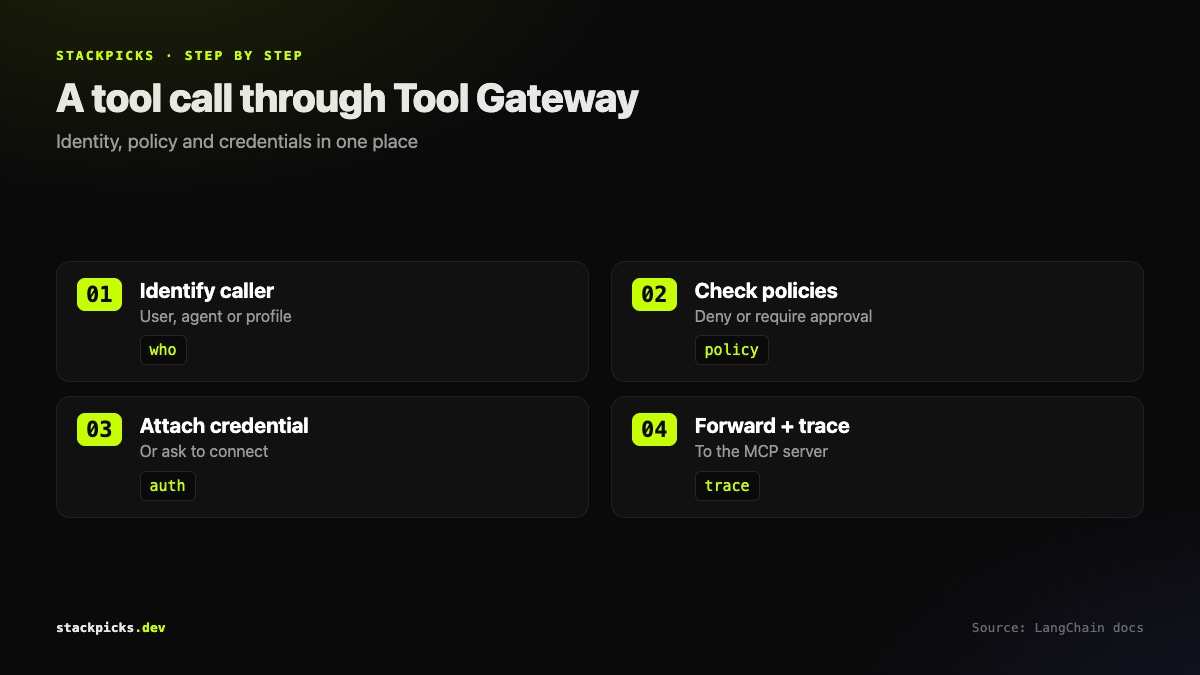
How a call flows
- Identify the caller: user, agent or profile.
- Deny the call if a deny policy matches.
- Attach the stored credential, or ask the caller to connect the account.
- Ask for approval if an approval policy matches.
- Forward the call to the MCP server and record a trace if tracing is on.
What you get
- Tool kits you add to Claude Code, Cursor or another MCP client with a single URL.
- Built-in servers for common services, plus your own remote MCP servers, and private servers through a tunnel.
- Traces showing which tool ran and as whom.
- Policies that block calls or require approval.
Plans and regions
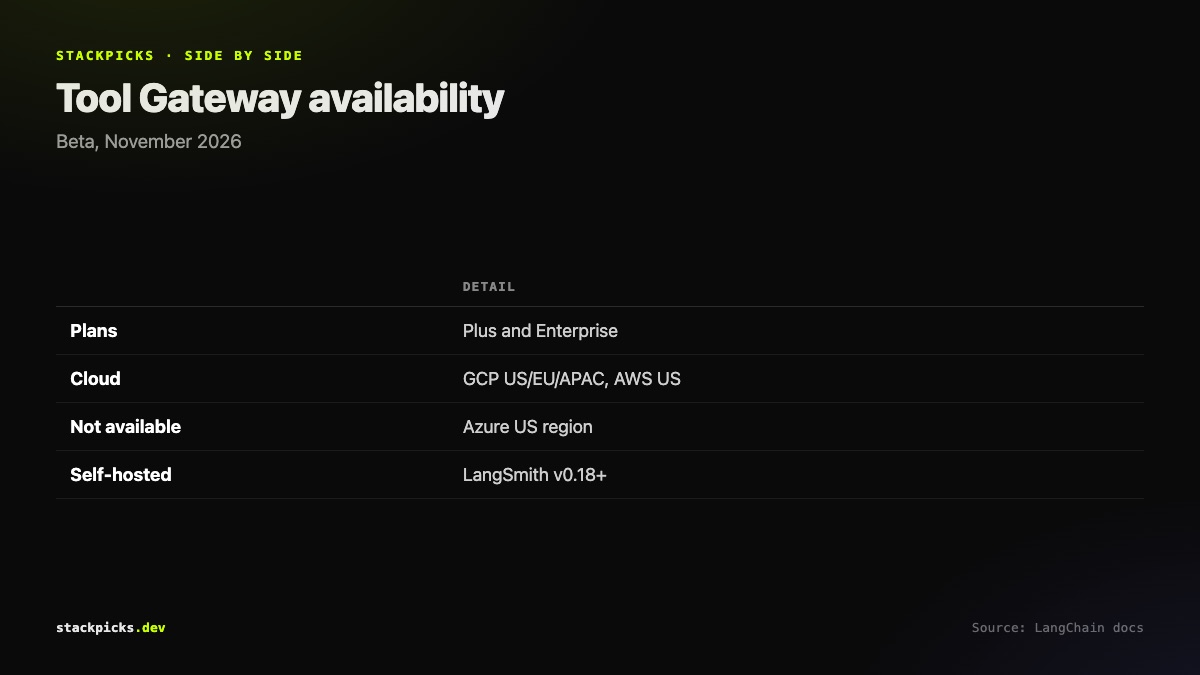
| Detail | |
|---|---|
| Plans | LangSmith Plus and Enterprise |
| Cloud regions | GCP US, GCP EU, GCP APAC, AWS US (not Azure US) |
| Self-hosted / BYOC | LangSmith v0.18+ |
Do you need one?
- **Solo developer, a few servers:** probably not. Configure servers directly; see the best MCP servers for Claude Code.
- Team with shared credentials and audit needs: yes, a gateway beats keys scattered across laptops.
- **Comparing options:** we also cover a single-endpoint approach in one MCP for all apps.
Whichever you pick, the MCP security checklist still applies.