**Short version:** a desk-sized cluster for people who write HPC and AI code and want to test multi-node jobs before booking time on a real supercomputer. Details are from NVIDIA's SC26 blog post.
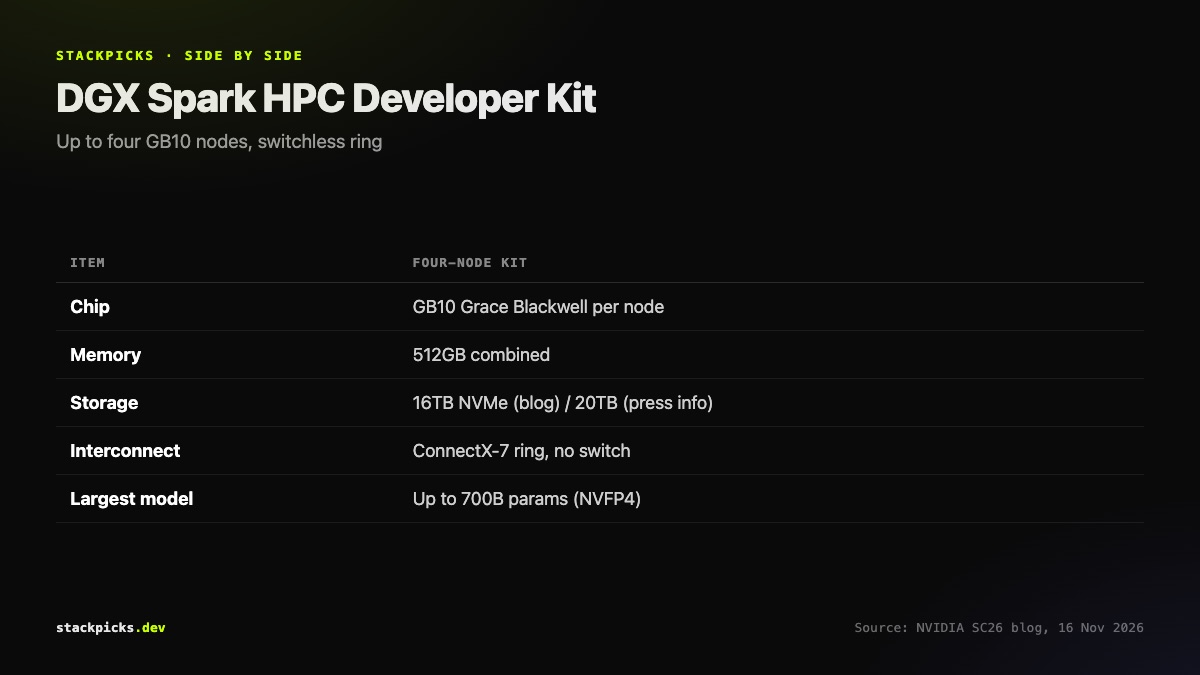
What is in the kit
| Item | Four-node kit |
|---|---|
| Nodes | 1 to 4 DGX Spark systems |
| Chip | GB10 Grace Blackwell Superchip per node |
| Memory | 512GB combined |
| Storage | 16TB NVMe (blog); NVIDIA's press information says 20TB |
| Interconnect | ConnectX-7, each node wired to its two neighbours, no switch |
| Largest model | Up to 700B parameters with NVFP4 (e.g. DeepSeek V4.1) |
The storage figure differs between NVIDIA's own documents, so confirm the final configuration with the seller before you buy.
Software and validated apps
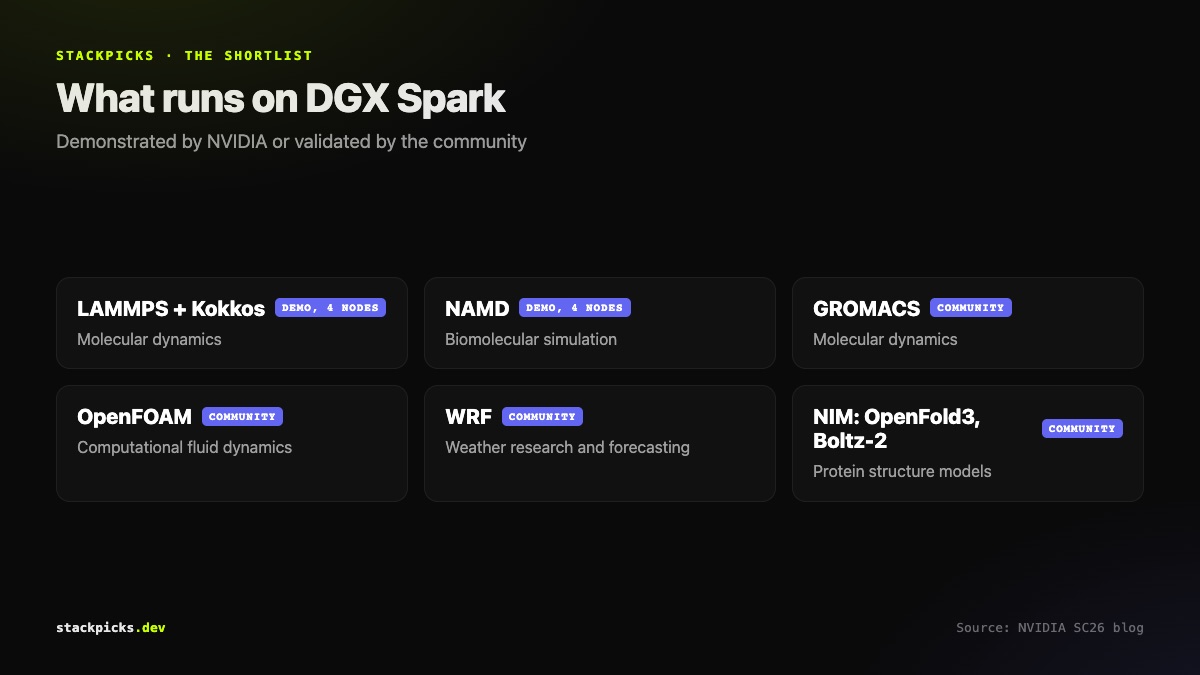
NVIDIA demonstrated LAMMPS (with Kokkos) and NAMD across four systems. The wider DGX Spark community has validated GROMACS, OpenFOAM and WRF, plus NIM microservices such as OpenFold3 and Boltz-2. The HPC SDK playbook (C, C++ and Fortran compilers, libraries, MPI tools) is listed as coming soon, so plan on setting up the toolchain yourself for now.
Who it is for
- Researchers and HPC developers who need to debug MPI and multi-GPU code locally.
- **AI teams** that want to serve very large open models privately; see our list of open-source LLMs to run locally and local LLMs for coding.
- Not a replacement for a production supercomputer: four desk nodes are a development and teaching rig.
Where to buy
Through NVIDIA Marketplace and OEM partners: Acer, ASUS, Dell Technologies, GIGABYTE, H3C, HP, Lenovo, MSI and xFusion. NVIDIA did not publish a price. Comparing with the Windows-based RTX Spark? See RTX Spark vs DGX Spark. For the science models NVIDIA tuned to run on a single 128GB DGX Spark, read Nemotron for Science.