All posts
AI Engineering·5 min read·Updated 25 Nov 2026

NVIDIA Nemotron for Science: Open Model, Chemistry Dataset and What Early Users Got

Quick answer
Nemotron for Science, announced on 16 November 2026, packages NVIDIA's open Nemotron 3.5 Super VL model with scientific evaluations, post-training recipes and LitmusBench v0.2, an open chemistry dataset of nearly 50,000 questions. The model runs locally on a 128GB DGX Spark and is on Hugging Face.

Nemotron for Science bundles Nemotron 3.5 Super VL, the LitmusBench v0.2 chemistry dataset and post-training recipes for research agents. Results reported by Lila, Terray, Therna and KTH.

Piyush

Founder of StackPicks, based in Mumbai, India. Every tool recommended here is checked on GitHub first; see how we pick.

5 min read
NVIDIA Nemotron for Science: Open Model, Chemistry Dataset and What Early Users Got

**Short version:** not a new model, but a kit for turning NVIDIA's open vision-language model into a research agent. Facts are from NVIDIA's announcement.
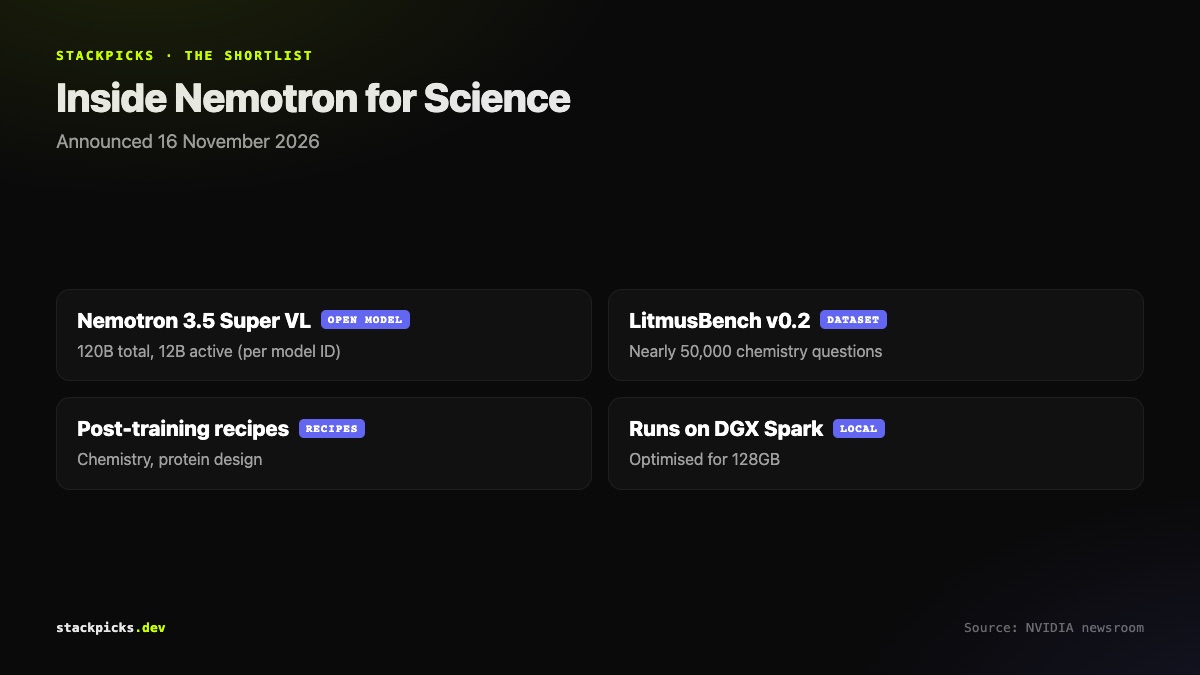
What is in Nemotron for Science: model, LitmusBench dataset, recipes and evaluations

What is in it

  • Nemotron 3.5 Super VL, an open vision-language model. Its Hugging Face ID (NVIDIA-Nemotron-3.5-Super-VL-120B-A12B-BF16) indicates 120B total and 12B active parameters.
  • LitmusBench v0.2: nearly 50,000 chemistry reasoning questions drawn from molecular properties and drug discovery data.
  • Post-training recipes for tasks such as chemistry experiments and protein design, plus scientific evaluations.
  • Optimised to run locally on a 128GB DGX Spark.

What early users reported

These are NVIDIA-reported results from partners, not independent benchmarks.
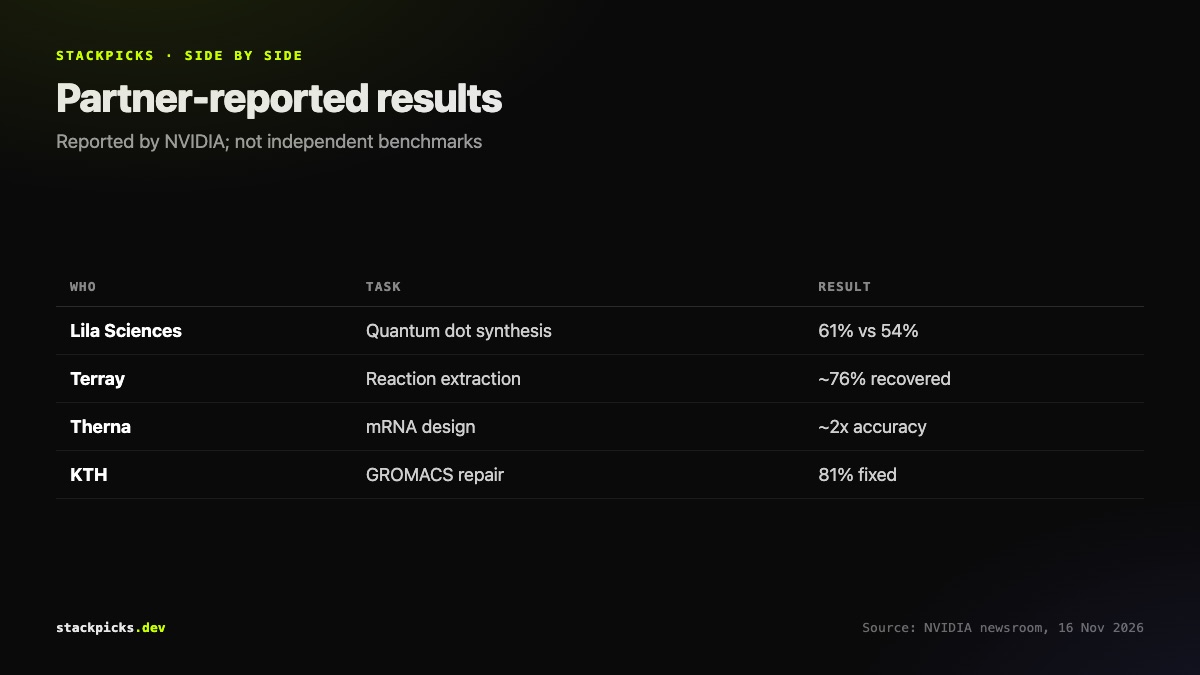
Early results reported for Nemotron for Science by Lila Sciences, Terray, Therna and KTH

WhoTaskReported result
Lila SciencesQuantum dot synthesis protocols61% accuracy vs 54% for a frontier model, at 10-20x lower inference cost
Terray TherapeuticsExtracting reactions from diagrams~76% of annotated reactions recovered (RxnScribe)
ThernamRNA therapeutic designNearly doubled accuracy on protein-expression range prediction
KTHRepairing broken GROMACS setups81% of test cases fixed overnight on one DGX Spark

Getting started

  1. Download the model and LitmusBench from Hugging Face.
  2. Run it locally (DGX Spark or a GPU server with enough memory).
  3. Follow NVIDIA's post-training blog to adapt it to your domain.

For the agent layer around the model, compare frameworks in our open-source AI agent frameworks guide, and see the best open-source LLMs to run locally for alternatives. Hardware options: DGX Spark HPC kit.

Frequently asked questions

What is NVIDIA Nemotron for Science?+

Nemotron for Science is a package NVIDIA announced on 16 November 2026 for building AI research agents. It combines the open Nemotron 3.5 Super VL model, scientific evaluations, post-training recipes for tasks like chemistry experiments and protein design, and LitmusBench v0.2, a new open chemistry dataset. The model was optimised to run locally on a 128GB NVIDIA DGX Spark.

What is LitmusBench?+

LitmusBench v0.2 is an open dataset from NVIDIA with nearly 50,000 questions for training and evaluating language models on chemistry reasoning. It draws on molecular property and experimental drug discovery data, targeting predictions such as solubility and how the body processes molecules. Questions derived from ChEMBL are licensed CC BY-SA 4.0, and the rest under OpenMDW 1.1. It is available on Hugging Face.

Is Nemotron 3.5 Super VL a new model?+

No. Nemotron 3.5 Super VL was published on Hugging Face in October 2026, before the SC26 announcement. Nemotron for Science adds the dataset, evaluations and post-training recipes around it. The Hugging Face model ID, NVIDIA-Nemotron-3.5-Super-VL-120B-A12B-BF16, indicates a mixture-of-experts model with 120 billion total and 12 billion active parameters, which keeps inference cost low.

Are the Nemotron for Science results independent?+

No. The results NVIDIA published, such as Lila Sciences reaching 61% accuracy on quantum dot synthesis and KTH fixing 81% of broken GROMACS setups, were reported by NVIDIA and its partners. They are useful signals but not independent benchmarks. If you plan to rely on the model, run it on your own evaluation set, which LitmusBench can help you build.

More in AI Engineering