All posts
AI Engineering·8 min read·Updated 18 Sept 2026

Open-Source Alternatives to ElevenLabs in 2026: Chatterbox, VoxCPM, GPT-SoVITS and More

Quick answer
The strongest open-source ElevenLabs alternatives in 2026 are Chatterbox for multilingual voice cloning, VoxCPM and GPT-SoVITS for high-quality cloning, and Kokoro for small, fast text-to-speech. Check model licences before commercial use: F5-TTS code is MIT, but its pretrained models are non-commercial.

Open-source text-to-speech and voice cloning alternatives to ElevenLabs: Chatterbox, VoxCPM, GPT-SoVITS, F5-TTS and Kokoro — licences for commercial use, maintenance status and consent.

Piyush Jangir
Verified author

Founder of StackPicks. Self-taught builder shipping open-source dev tools, marketing, and curator content since 2019. Based in Mumbai, India. Available on GitHub and LinkedIn.

8 min read
Open-Source Alternatives to ElevenLabs in 2026: Chatterbox, VoxCPM, GPT-SoVITS and More

Short version: for multilingual voice cloning, start with Chatterbox. For high-quality cloning, compare VoxCPM and GPT-SoVITS on your own voice. For fast, lightweight speech, Kokoro. Before shipping anything commercial, read the licence of the model weights, not just the code: they can differ. Stars and push dates below are from the GitHub API on 18 September 2026.
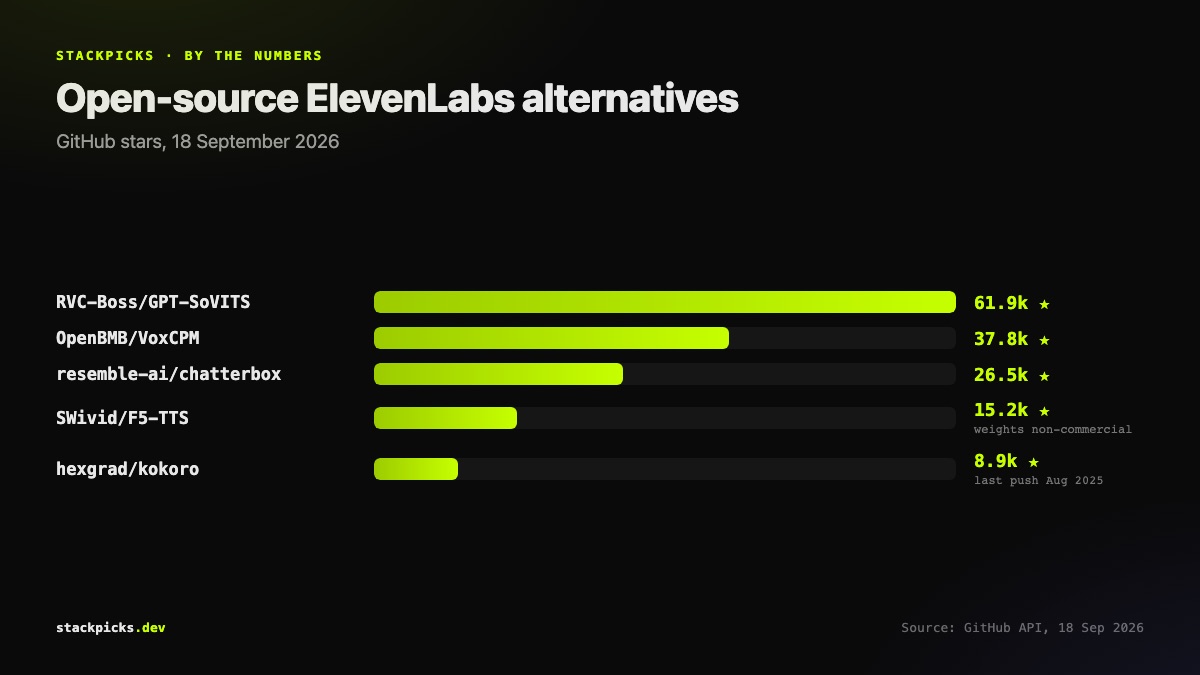
Open-source ElevenLabs alternatives by GitHub stars

The shortlist

**GPT-SoVITS** (about 62,000 stars, MIT) is a widely used voice cloning and TTS system, actively developed.

**VoxCPM** (about 38,000 stars, Apache-2.0) from OpenBMB, with version 2.0.3 released in May 2026 and recent commits.

**Chatterbox** (about 26,000 stars, MIT) from Resemble AI. Its Multilingual V3 model keeps a 0.5B size while improving speaker similarity across languages, and dedicated single-language packs target priority languages.

**F5-TTS** (about 15,000 stars). The code is MIT, but the pretrained models are CC-BY-NC, so the published weights are for non-commercial use only.

**Kokoro** (about 9,000 stars, Apache-2.0) is a small text-to-speech model that runs on a CPU. It is not a cloning tool, and its last code push was in August 2025.
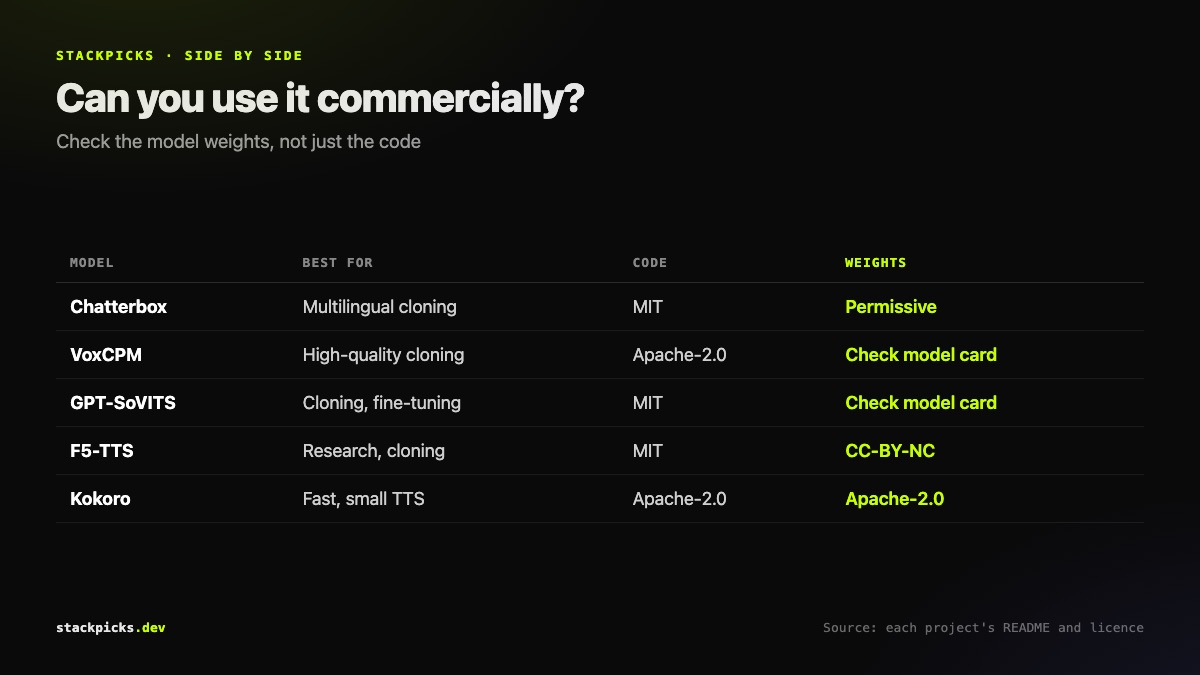
Licences and fit for open-source TTS models

What to avoid for new projects

Coqui TTS was the default for years, but the company shut down and the repository has not been updated since 2024. OpenVoice last saw a code push in April 2025.

How to choose

  1. Decide: cloning or plain speech?

- Cloning: Chatterbox, VoxCPM or GPT-SoVITS.

- Plain narration: Kokoro.

  1. Check the weights licence.

- Commercial use needs a permissive licence on the model files.

  1. Test in your language.

- English demos say little about Hindi or Tamil quality.

  1. Get consent in writing.

- Open-source tools skip the platform's consent checks.

For hosted options and a wider comparison, see our AI voice cloning tools guide.

Frequently asked questions

Can I use open-source TTS commercially?+

Often, but check the model licence, not just the code licence. They can differ. F5-TTS is the clearest example: its code is MIT, but its pretrained models are licensed CC-BY-NC because of the dataset they were trained on, which rules out commercial use of those weights. Chatterbox, VoxCPM, Kokoro and GPT-SoVITS publish permissive code licences, but confirm the licence on the exact model files you download.

Which open-source model is closest to ElevenLabs quality?+

For voice cloning, Chatterbox, VoxCPM and GPT-SoVITS are the usual shortlist in 2026, and Chatterbox's latest multilingual model emphasises speaker similarity across languages. Quality depends heavily on your reference audio and language. Test each with your own voice and script, because demos are chosen to flatter, and the best model for English may not be the best for Hindi or Tamil.

Do I need a GPU to run these models?+

For voice cloning at reasonable speed, a GPU helps a lot. Small text-to-speech models such as Kokoro, at around 82 million parameters, run on a CPU. Larger cloning models run on a CPU too but slowly, which is fine for batch jobs such as narrating an article and painful for anything interactive. Apple Silicon Macs are a practical middle ground.

Is it legal to clone a voice with these tools?+

Cloning your own voice is fine. Cloning anyone else's without clear, written permission is not, and courts in India and elsewhere have treated a person's voice as a protected personality right. Open-source tools remove the platform's consent checks, which makes the responsibility entirely yours. Get consent in writing and keep it on file.

What happened to Coqui TTS?+

Coqui, the company behind the popular Coqui TTS library and XTTS models, shut down, and the main repository has not received code changes since 2024. The code is still available and still used, but nothing is being fixed or updated. For new projects, prefer one of the actively maintained options.

More in AI Engineering

Open-Source Alternatives to ElevenLabs in 2026: Chatterbox, VoxCPM, GPT-SoVITS and More — StackPicks — StackPicks