**Short version:** Rubin HPC is NVIDIA's answer to scientists who need double-precision-style simulation throughput rather than AI tokens. It is two years out, so treat it as a roadmap signal. Facts are from NVIDIA's Rubin HPC announcement.
What NVIDIA announced
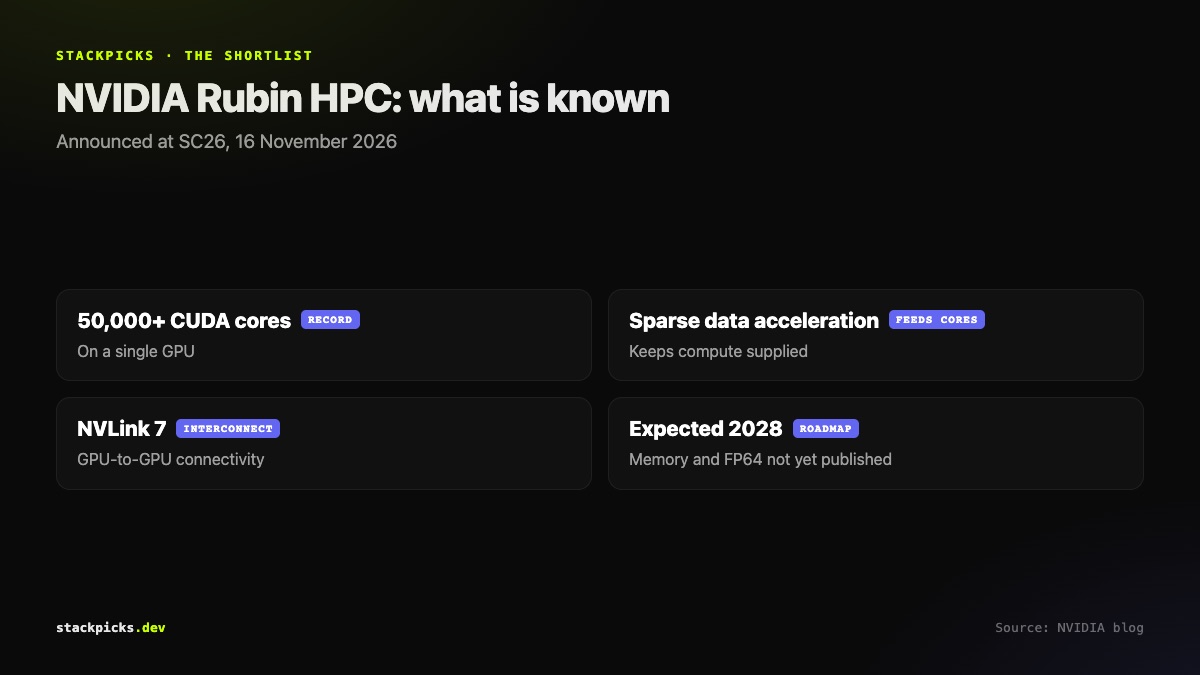
- More than 50,000 CUDA cores on a single GPU, which NVIDIA calls a record.
- Sparse data acceleration to keep those cores fed.
- Seventh-generation NVLink for GPU-to-GPU links.
- A design where data movement scales with compute, not compute alone.
- Expected in 2028.
NVIDIA has not published memory type, memory capacity or FP64 performance.
What it is for
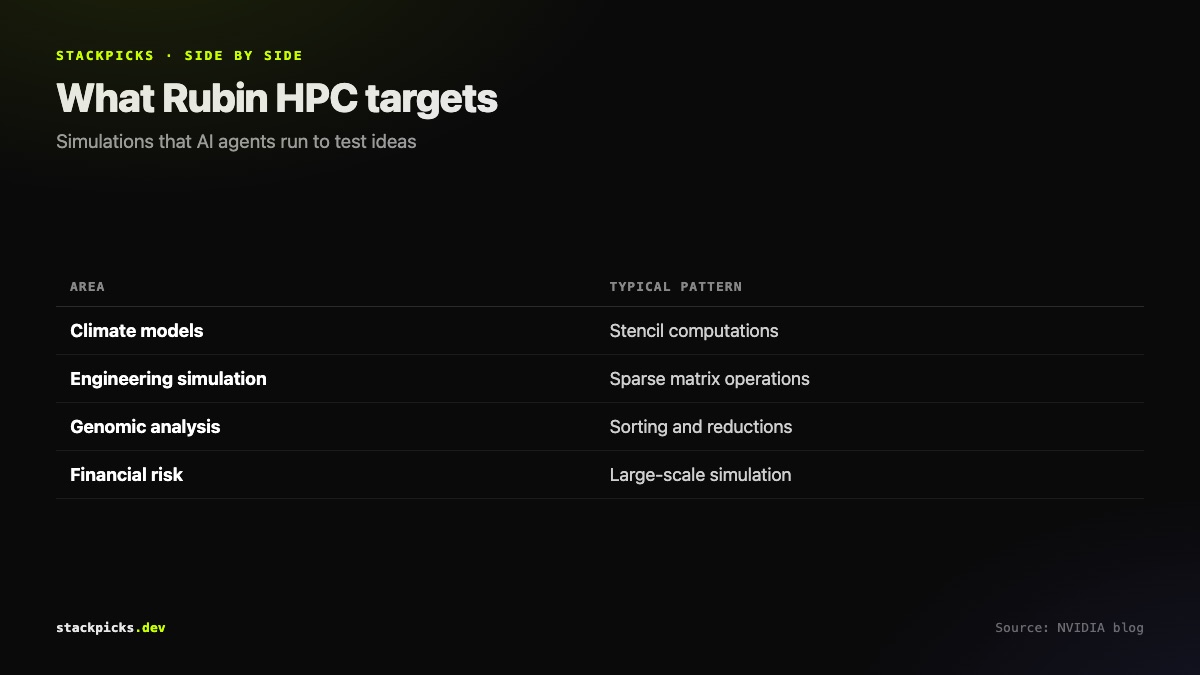
NVIDIA frames Rubin HPC around the simulations agents use to test candidate materials, molecules and designs: climate models, engineering simulation, genomics and financial risk. The common patterns it names are sparse matrix operations, stencil computations, sorting and reductions, served by CUDA-X libraries.
Should you care now?
Only if you plan HPC procurement for 2028. For everything before then, the shipping options are Vera Rubin NVL72 in data centres (see the Q3 results) and the DGX Spark HPC kit on the desk. NVIDIA paired the announcement with open science models; see Nemotron for Science. For agent frameworks that can drive simulations, our open-source AI agent frameworks comparison is the place to start, and the best open-source LLMs to run locally covers the models.