
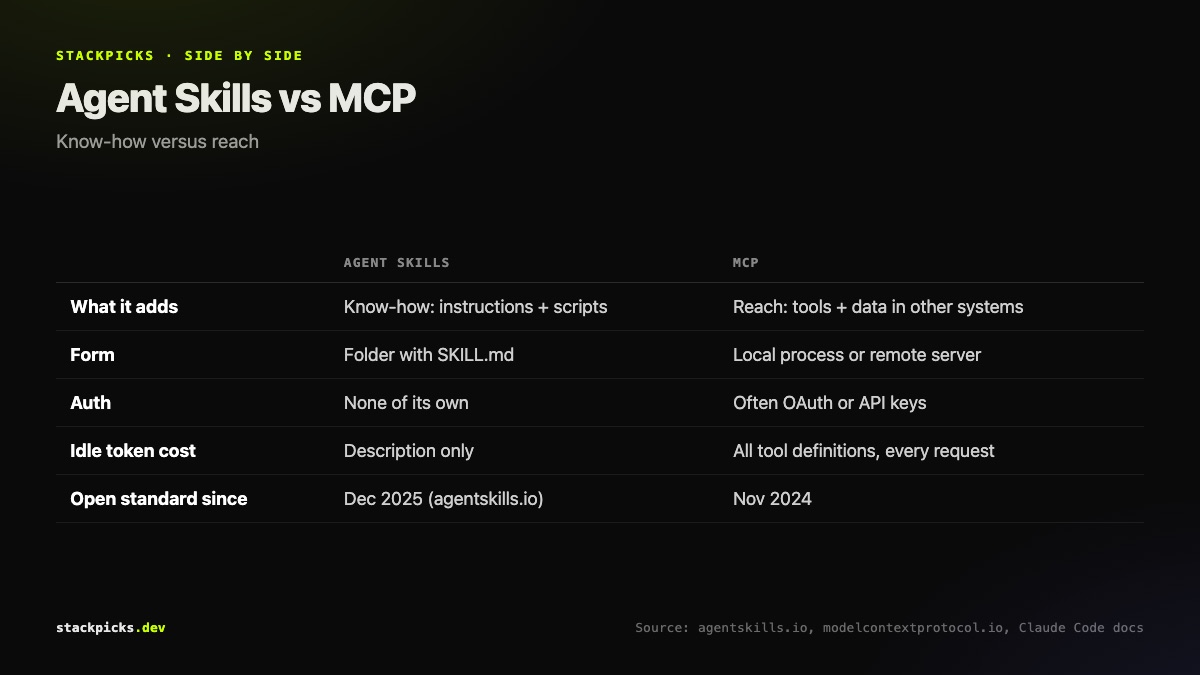
Short version: a skill is know-how, an MCP server is reach. Skills tell the agent how to do a job with the access it already has. MCP gives it access to something it could not touch before. Most real workflows use both, and both are open standards that work across Claude Code, Codex, Gemini CLI and more.
What a skill is
A skill is a folder with a SKILL.md file: YAML frontmatter with a name and description, then instructions, plus optional scripts and reference files. In Claude Code, personal skills live in ~/.claude/skills/ and project skills in .claude/skills/. The agent reads the description and loads the full skill only when a task needs it.
Agent Skills was published as an open standard at agentskills.io in December 2025, and Codex, Gemini CLI, GitHub Copilot, Cursor and VS Code read the same format.
What MCP is
The Model Context Protocol connects an agent to external systems through servers that expose tools and data. A server might be a local process, such as Chrome DevTools, or a remote service with OAuth, such as Atlassian's. Anthropic released MCP in November 2024; the 2026-07-28 specification is current.
The token difference
Skills are cheap when idle: only their descriptions sit in context until one is needed. MCP servers are not: every connected server's tool definitions load into every request. That asymmetry is why a dozen skills cost less than a dozen servers, and why pruning idle servers is a quick way to reduce Claude Code token usage.
When to use which
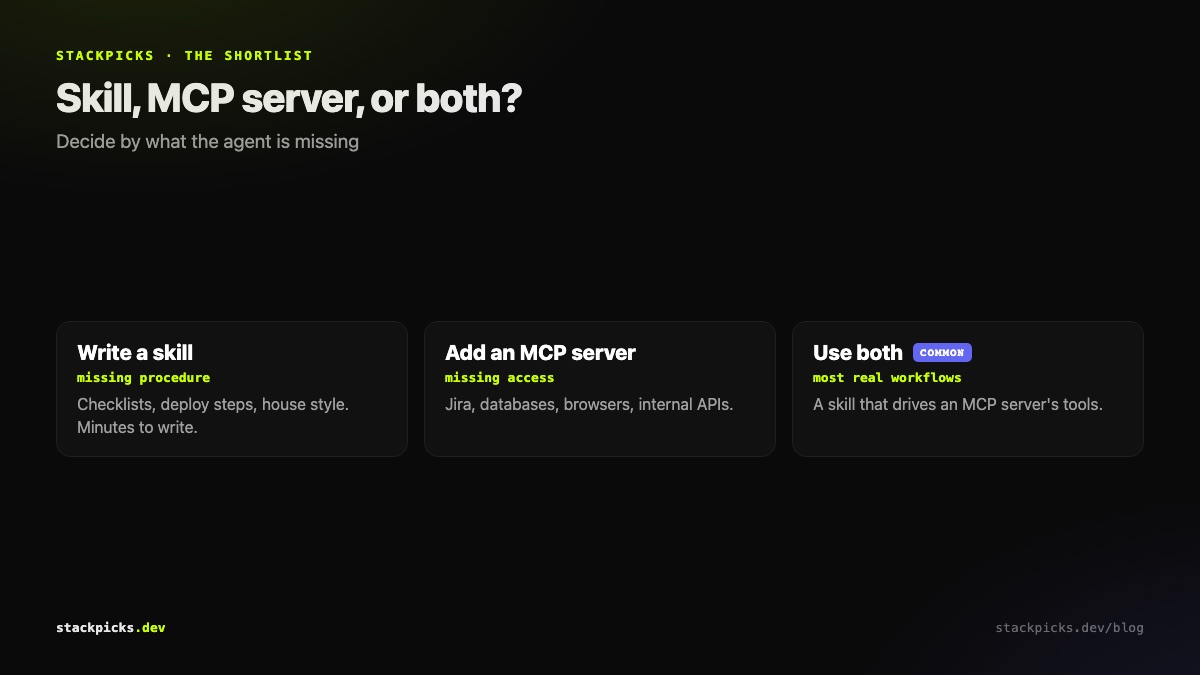
- The agent has access but lacks the procedure: write a skill.
- Review checklists, deploy steps, house writing style.
- The agent cannot reach the system: install or build an MCP server.
- Jira, a database, a browser, an internal API.
- Both: a skill that uses an MCP server's tools.
- Google's stitch-skills pairs with the Stitch MCP server this way.
- Unsure: start with a skill; it takes minutes to write.
Browse both: the Agent Skills directory and the MCP directory.